Sergeyich is interviewed by the media at the border
Grey BeesSergeyich is interviewed by the media at the border after reaching Crimea with his bees from Donbas. The encounter turns his journey and damaged belongings into a possible public story, but its central tension lies in what he is allowed to say: when he names Russians as one side of the war, a media worker tells him to repeat himself without that word. The interview does not proceed as an account in his own terms; instead, cameras record his car and hives, and the journalists later give him money for repairs.
Setting and invitation
At the Russian border post, an official responds sympathetically when he learns that Sergeyich is from Donbas, describing conditions there as horrible and saying that people must speak out about them. He asks whether Sergeyich would speak with journalists about the incident. The invitation follows a border crossing already marked by scrutiny: soldiers have checked Sergeyich’s passport and mobile phone, and he has passed a line of people traveling with carts, suitcases, bags, and backpacks before arriving at the post.
Before the journalists arrive, an office worker offers Sergeyich tea and lays a map of Donbas on the desk. Asked to find his village, Sergeyich points to Little Starhorodivka; the man circles it in red pencil and asks about life in the grey zone and about Pashka. The map turns the village into a marked place for the coming conversation, while the questions establish that the proposed interview is meant to explain both the region and the beekeeper’s circumstances.
The interview and its limits
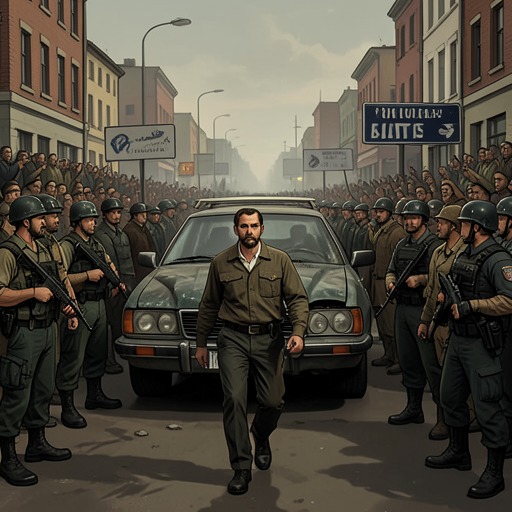
About five people gather beside Sergeyich’s green Lada. Two cameramen film the car, trailer, and hives from different angles, while a young woman with a microphone asks whether he is ready to tell his story. She places him in front of his car and begins by asking why he came from Donbas. Sergeyich gestures toward the trailer and struggles to frame his answer: his bees are with him, he says, and there is a war in the grey zone, with Ukrainians on one side and Russians on the other.
A young man immediately interrupts. He orders Sergeyich to stop and repeat the statement without “Russians,” challenging how Russians could be present on the other side. Sergeyich complies more hesitantly, replacing the description with a reference to separatists from Karuselino. The correction is the encounter’s decisive turn: the interview has invited a witness to explain his flight, yet the account is redirected at the moment he names one of the forces he says is involved. His revised wording is less direct and more tentative, showing the gap between what he has experienced and the version the crew will permit on camera.
The young woman then asks about the damage to his car. Sergeyich says that one man smashed it in the Zaporizhia region, where he had stopped briefly, and explains that the man had been drinking at a wake for a soldier killed by Russians. The young man interrupts again, tells the interviewer that there will be no live interview, and instructs the crew to film instead. He specifically asks them to record the bees buzzing and take a close-up of the axe mark on a damaged hive. The camera’s attention shifts from Sergeyich’s explanation to images that can stand in for it.
From testimony to footage
After the interview is stopped, the young woman lowers her microphone and walks away without speaking to Sergeyich. The cameramen continue filming his car and hives, including through the Lada’s broken windscreen. Their glances seem detached from the sympathy that had framed the invitation. A border guard also examines the hives with a small electronic device, moving it along them and listening to its signals. The beekeeper’s arrival is thus recorded and inspected at once: the crew gathers images, while the guard checks the cargo.
The episode echoes an earlier scene in which Sergeyich watches television at Nastasya’s. A panel of men discusses Ukraine and blames America and Europe for supporting Ukrainians; after the channel is changed, a woman with green dye on her face appears on screen, declaring that she is entitled to her opinion. In both scenes, political speech reaches Sergeyich through a screen or a camera, and the framing matters: televised argument reduces the conflict to competing claims, while the border crew tries to shape what the beekeeper may say about the war he has crossed from.
Aftermath and significance
Sergeyich gets back behind the wheel, but the man who dismissed the interview runs after him and asks him to wait. He explains that the journalists have pooled money for car repairs and hands Sergeyich a fistful of banknotes. They say they will be in touch about the programme “Then and Now.” The offer does not undo the interruption or restore the interview he was prevented from giving, but it gives the encounter a material consequence beyond filming: the crew contributes to repairing the vehicle that carried him and his bees across the border.
The scene holds two forms of attention in tension. Sergeyich’s testimony is narrowed when he names Russians, while the damaged car and axe-marked hive remain available as images. Yet the journalists’ collection also acknowledges a concrete need that the edited footage alone cannot meet. As Sergeyich later continues through the border process and drives across the buffer zone, the interview remains one episode in a journey governed by checkpoints, documents, and controlled routes. Its significance lies in showing that crossing a border is not only a matter of movement: it also places a person’s account of the war before institutions and media that may select, revise, or replace his words.